

Illustration by Anna Denardin, Edge Finance
Creating the Conditions for the Emergence of Cascadia Landscape Hubs
We are excited to announce the launch of our long-planned Landscape Hub Cultivator (LHC) 2025-26 pilot starting in late fall of this year! As part of our mission to support landscape-scale regeneration and grow a bioregional funding ecosystem across the Cascadia Bioregion, the LHC will support up to 10 Regenerate Cascadia Landscape groups across Cascadia through an online community of practice to co-create and define what a Landscape Hub is and develop its core foundations.
The Landscape Hub Cultivator pilot (LHC) is a chance to playfully engage with the following opportunities:
- interrupt existing systemic patterns to create a cultural shift, where right relationship to the land is a guiding principle;
- value and nurture networks of relationships as critical for building and holding trust;
- develop and practice new/old forms of participatory governance essential for nested-scale bioregional organizing; and
- develop the bioregional infrastructure required to attract and flow funding to where it is needed in Cascadia.
Landscape Hubs - An Essential Bioregional Organizing Structure
As a pilot, this program is all about learning together by doing—testing and modeling Regenerate Cascadia’s theory of change on developing BioFi funding pathways through action and reflection in real communities. We think that to make long-term bioregional regeneration and bioregional finance (BioFi) a reality, Landscape Hubs need to exist as regional organizing bodies that develop and engage core processes and cultures essential to bioregional-level collaboration and financing systems. Another assumption is that central to a Hub’s effectiveness is a financially supported Landscape Regeneration Team of at least three dedicated group stewards. The LHC pilot exists for us to test these assumptions within our theory of change and discover together what the work looks like in practice.
Just as a bicycle wheel needs a certain number of spokes to support its structure and function, we think Landscape groups require certain elements to be in place to organize and function as a Landscape Hub within an overarching bioregional regeneration strategy. The LHC pilot will guide groups through these foundational ‘spoke development’ elements, such as bioregional mapping, levels of stewardship, and development of Landscape Regeneration Teams that will function as the key coordination, administration, and ‘backbone’ to their eventual Landscape Hub.
The first six months will focus on co-creating place-based regeneration strategies for each participating landscape that includes bioregional mapping, nested scales of place, and layers of stewardship. Participants will also co-create a portfolio of regenerative projects from their landscape, with a correlating budget and story deck to share with community members and funders. The second six months will focus on core team development, fundraising strategies, governance, community consent, bioregional carrying capacity, context-based indicators, and building a local funding ecosystem.
Our Working Definition of a Landscape Hub
While every Landscape Hub will take its own unique shape, at this stage in the work we envision an established Landscape Hub to be a long term goal, which embodies the following features and activities:
- Have a funded regeneration team in place to ensure the work is consistently supported
- Actively participate in both local fundraising for their Hub and our Cascadia bioregional fundraising strategy
- Have developed and maintain a regenerative project portfolio, local regeneration strategy, action plan, and budget—whilst ensuring that relationship, learning and land attunement inform the work
- Participate in developing a bioregional financing facility and funding ecosystem that funds Landscape Hub project portfolios and regeneration strategies
- Monitor and sustain watershed-scale measurement, reporting and verification, context-based indicators, and bioregional carrying capacity for long-term regeneration
- Participate in bioregional forums to support whole system feedback, learning, and resource-sharing mechanisms
- Be willing to engage the leading edge in co-creating new/old forms of participatory governance, particularly in relationship to managing funding flows and finance systems
The Landscape Hub Cultivator is designed to be an immersive journey in supporting Landscape Groups to experiment with the above features and activities. We’re excited to embark on this journey together, rooted in our shared bioregional values of deep relationship to place, co-stewardship, building trust through being and doing together, and collaborative regeneration!
Landscape Hub Cultivator Core Elements
Not a Traditional Course—a Cohort Community: The LHC is not a typical learning journey or public course. It’s a structured cohort program, delivered through bespoke curriculum and activities, mentorship and peer learning, held within an online community of practice.
2-3 Participants Per Landscape Group: The LHC invites 2-3 people from each Landscape Group to participate in the pilot as Landscape Stewards representing their group. It’s important for groups to reflect on which members are best positioned to participate and serve as a bridge between the pilot and their group, who will be involved in key activities and outputs throughout the pilot.
Online Learning Structure, Events and Community of Practice: Each group’s Landscape Stewards will engage with the core LHC delivery team, RC partners and peers through bi-weekly online learning sessions to share content, processes, and activity guides. Regular Office Hours will be available to provide coaching and mentoring around the LHC’s activities. The pilot will also feature a number of events showcasing participating Landscape Groups to funders and facilitating dialogue and learning between land stewards and funders. The LHC online community of practice will be held on the Mighty Networks platform and will feature:
- Program calendar and posts for all learning activities
- Office Hours booking
- A ‘Land Steward Lounge’ for LHC participants to meet, share and support each other
- Dialogue, reflection, and co-learning through guided discussions, topic/activity posts and threads
- A central resource hub for all program resources, activity and process guides, and space for resource-sharing amongst participants/groups
- Archive of all session recordings, templates, materials and other resources
Financial Support for Participating Landscape Groups: While some of the components of the LHC are subject to change as we further design and respond to emergence, the LHC pilot will likely unfold in three phases. Below is an overview of each phase, including key activities, timelines, and funding support. In total, each landscape group will receive $8,000 in direct support through the pilot (approximately $5,000 for planning/mapping activities and $3,000 for a flow funding sandbox) from our budget this year.
Additional funding requests to support the formation, development and income needs for future Landscape Regeneration Teams will be included in our 2026/27 budget as part of Phase 3 of the pilot. As confirmation of RC’s next year of funding will not be available until March/April 2026, no budget amounts can be confirmed at this stage.
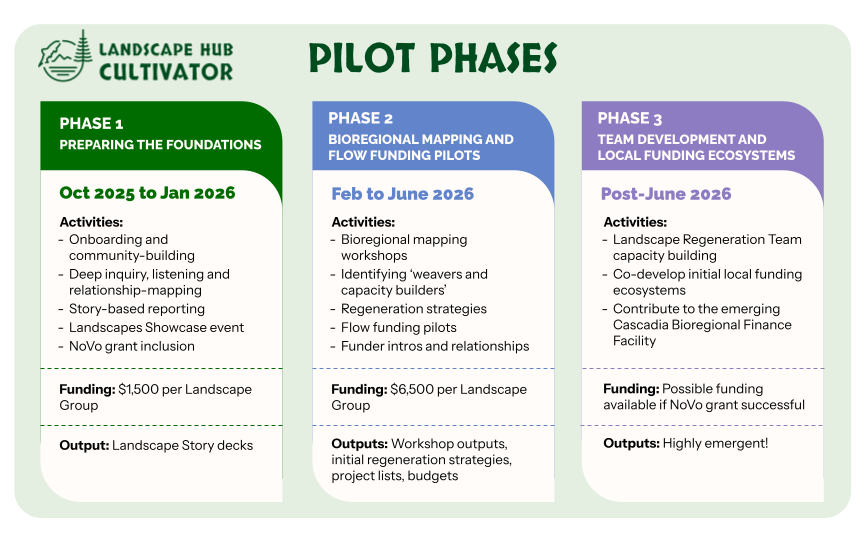
Phase One: Preparing the Foundations (Oct 2025 – Jan 2026)
Key Focus Areas and Activities:
- Online Landscapes community of practice launches, connecting participating bioregional organizing teams into a co-learning space
- Foundational landscape inquiry, deep listening, relationship-mapping processes
- Initial preparation for bioregional mapping
- Develop story-based reporting capacities with funded Landscape Story Decks ($1,500 per landscape)
- Landscape narratives included in Regenerate Cascadia’s grant applications for the next funding cycle
- Landscape Showcase event with regenerators, funders, and partners

Phase Two: Bioregional Mapping and Flow Funding Pilots (Feb – June 2026)

Key Focus Areas and Activities:
- In-person Bioregional Mapping workshops held in each landscape ($3,500 per landscape) to identify unique stories of place, local 'weavers' and capacity-builders, and community-defined stewardship metrics
- Development of initial landscape regeneration strategies, including budgets and project selections
- Flow funding pilot—$3,000 per Landscape group to practice being a local funding hub through re-granting or flowing small amounts into community-led ideas in line with the landscape regeneration strategy
- Meaningful funder introductions and relationship-building to promote shared learning about BioFi and generate funding pathways
Phase Three: Core Team Development and Growing Local Funding Ecosystems (Post-June 2026)
Focus
Looking beyond the pilot, Phase Three is about sustaining momentum and expanding Landscape groups’ capacity to do the regeneration work and attract and manage funding, including exploring new/old forms of participatory governance. The second six months of June 2026 will focus on developing the emerging Landscape Regeneration Teams’ core capacities, growing local funding ecosystems within landscapes, and helping groups contribute to developing a Cascadia Bioregional Finance Facility such as a regeneration fund. At this stage in the LHC a lot of emergence and real-time learning will have unfolded that will directly shape the specific structure and activities of Phase Three. We will also have insight into how the complementary Cascadia BioFi program is developing and what funding opportunities are emerging. Phase Three will focus on how to harness these and develop the core capacities to do so.
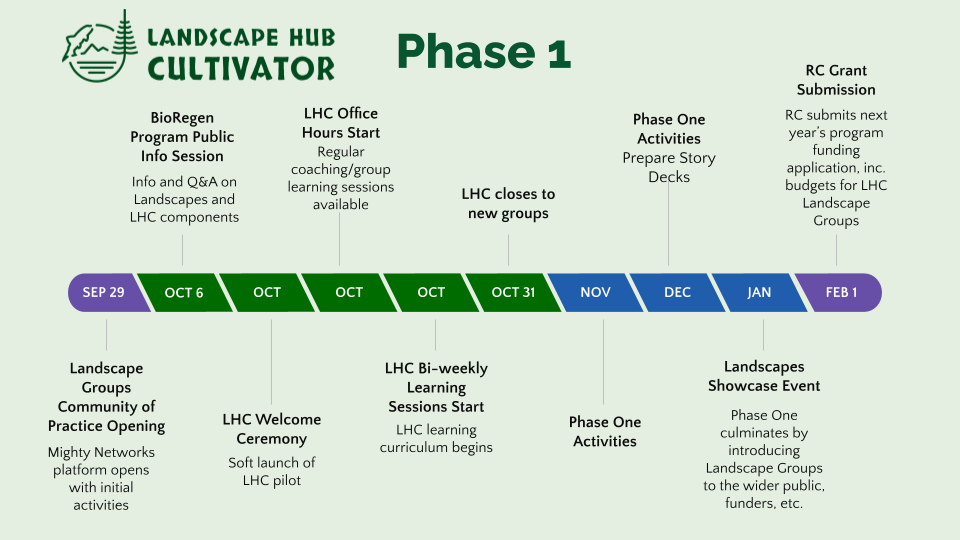
LHC Timeline and Key Dates for Phase one
Participant Requirements
The Landscape Hub Cultivator is an invite only program in that participants are the designated Land Stewards of each Regenerate Cascadia Landscape group formed through our BioRegen program. Participating Land Stewards are representatives of their Landscape group, responsible for connecting the work happening in the cultivator back to their local community. It is important they be available to be 1099 contractors for any stipends or honorariums we are able to provide. They should be connected with or able to connect with the regenerative work happening within their locality and keenly interested in exploring the central goals of Regenerate Cascadia—growing collaborative, participatory, governance capacities cohesively across the scales of landscapes, ecoregions, and bioregions—as part of a multi-generational strategy for the long-term health of the Cascadia bioregion.
We are very excited to embark on this next phase of our bioregional journey together in coordinated landscape regeneration and exploring BioFi as a tangible, practical reality!
Meet our LHC Coordinators

Clare Attwell
CO-ADMINISTRATOR, Victoria, Salish Sea (She/Her).
Clare is a textile and multi-media artist living in Victoria, British Columbia in the Salish Sea and is a co-founder and administrator of Regenerate Cascadia. When she is not working on her own art, she works as a community artist, using the arts in imaginative ways to help community groups explore complex issues such as cultural and spiritual identity, including community visioning. Clare Grew up in South Africa and moved to Canada as a young adult. She is deeply influenced by her early years in Africa under Apartheid. She creates predominantly large-scale wall hangings that evolve from her work with the community. She is especially interested in exploring what makes complex systems functional, particularly how they relate to organizations and social systems.

Brandon Letsinger
CO-ADMINISTRATOR, Seattle, Salish Sea (He/Him).
Brandon Letsinger is the co-founder and administrator of Regenerate Cascadia. He is also the executive director of the Department of Bioregion, co-producer of the Cascadia Northwest Arts and Music Festival and President of the Cascadia Association Football Federation. In the past, he also launched CascadiaNow! in 2005, which he stepped back from in 2017, as well as helping organize the Cascadia Poetry Festival, Cascadians Against White Supremacy, Yes Cascadia, Vote Cascadia, and the Cascadia Underground, an independent media center on Capitol Hill. He also runs a 6400′ square foot art space in the Ballard neighborhood of Seattle. His work has been featured in Time Magazine, Vice, USA Today, the Atlantic Monthly, NPR, the BBC, National Journal, Wall Street Journal, Business Insider, Canadian Broadcasting, as well as a host of local newspapers and radio segments.

Taya Seidler
LHC PROGRAM MANAGER, Australia, Minjungbal Country (she/her).
Taya is a deep generalist developing systemic strategies and building capacities to address and embrace the complex nature of our climate emergency. She specializes in mobilising collaborative networks of change agents across multiple disciplines to work together on the design and implementation of solutions. Taya was a core member of the delivery team for the 2023 Edge Prize Challenge hosted by Salmon Nation and the Terran Collective, and has been a core Regenerate Cascadia team member for two years. Her primary lens for prototyping solutions is systems thinking. She recognises Indigenous peoples as the original systems thinkers and practitioners and is grateful for and respectful of the knowledge and wisdom First Nations peoples have chosen to share with the global community.